Standard Business Sponsorship Australia
- Author Name : Shreya Yadav
- Published on October 02, 2026
- Category : Australia Migration
Hiring skilled workers from overseas can help Australian businesses address genuine workforce needs when suitable skills are not available locally. Standard Business Sponsorship (SBS) Australia provides an employer sponsorship framework for eligible businesses seeking to sponsor skilled overseas workers through relevant employer-sponsored visa programs.
A business must first be assessed as a suitable sponsor before it can use standard sponsorship arrangements. Under the current framework, a Standard Business Sponsor can sponsor workers for visas including the Skills in Demand visa (subclass 482) and the Skilled Employer Sponsored Regional (Provisional) visa (subclass 494).
What Is Standard Business Sponsorship in Australia?
Standard Business Sponsorship Australia is an approval that allows an eligible Australian business to sponsor skilled overseas workers for certain employer-sponsored visa pathways.
Sponsorship is only one part of the overall process. The employer generally needs to meet sponsorship requirements, nominate an appropriate position and worker, and ensure the visa applicant satisfies the relevant visa criteria.
The Department of Home Affairs states that a legally established and operating business can apply to become a sponsor, subject to meeting the applicable requirements.
Who Can Apply for Standard Business Sponsorship?
A business may be able to apply for standard business sponsorship if it is legally established and operating and can demonstrate that it meets the requirements for sponsorship.
The assessment can consider the nature of the business, its operations, compliance history and ability to meet sponsorship obligations.
Businesses should also understand that becoming an approved sponsor does not automatically mean that every overseas worker can be sponsored. The nominated occupation, position, worker and visa pathway must satisfy the relevant requirements.
Why Do Businesses Use Standard Business Sponsorship?
Australian employers may consider sponsorship when they have difficulty finding appropriately skilled workers in the local labour market.
Depending on the visa pathway, employers may need to demonstrate that they have attempted to recruit suitable Australian workers through labour market testing. Some occupations or circumstances may be exempt from this requirement.
Sponsorship can therefore form part of a broader workforce strategy for businesses experiencing genuine skill shortages.
Standard Business Sponsorship Requirements
Businesses considering SBS Australia should review several important areas before submitting an application.
- Operate a legitimate business
The business should be legally established and operating and able to demonstrate that it is actively conducting business activities.
- Meet sponsorship suitability requirements
The Department assesses whether a business is suitable to become a sponsor. Businesses should ensure that their information and supporting documentation accurately reflect their operations.
- Identify an eligible occupation
The position being sponsored must meet the requirements of the relevant visa program. The occupation must also be eligible under the applicable skilled occupation arrangements where required.
- Demonstrate a genuine position
The nominated position should correspond with the business’s actual workforce requirements and the duties associated with the nominated occupation.
- Meet employment requirements
Sponsors must comply with applicable employment conditions. For standard business sponsors, sponsored employees must generally work in the nominated occupation and be employed under a written contract.
How Does the Standard Business Sponsorship Process Work?
The process generally involves several stages.
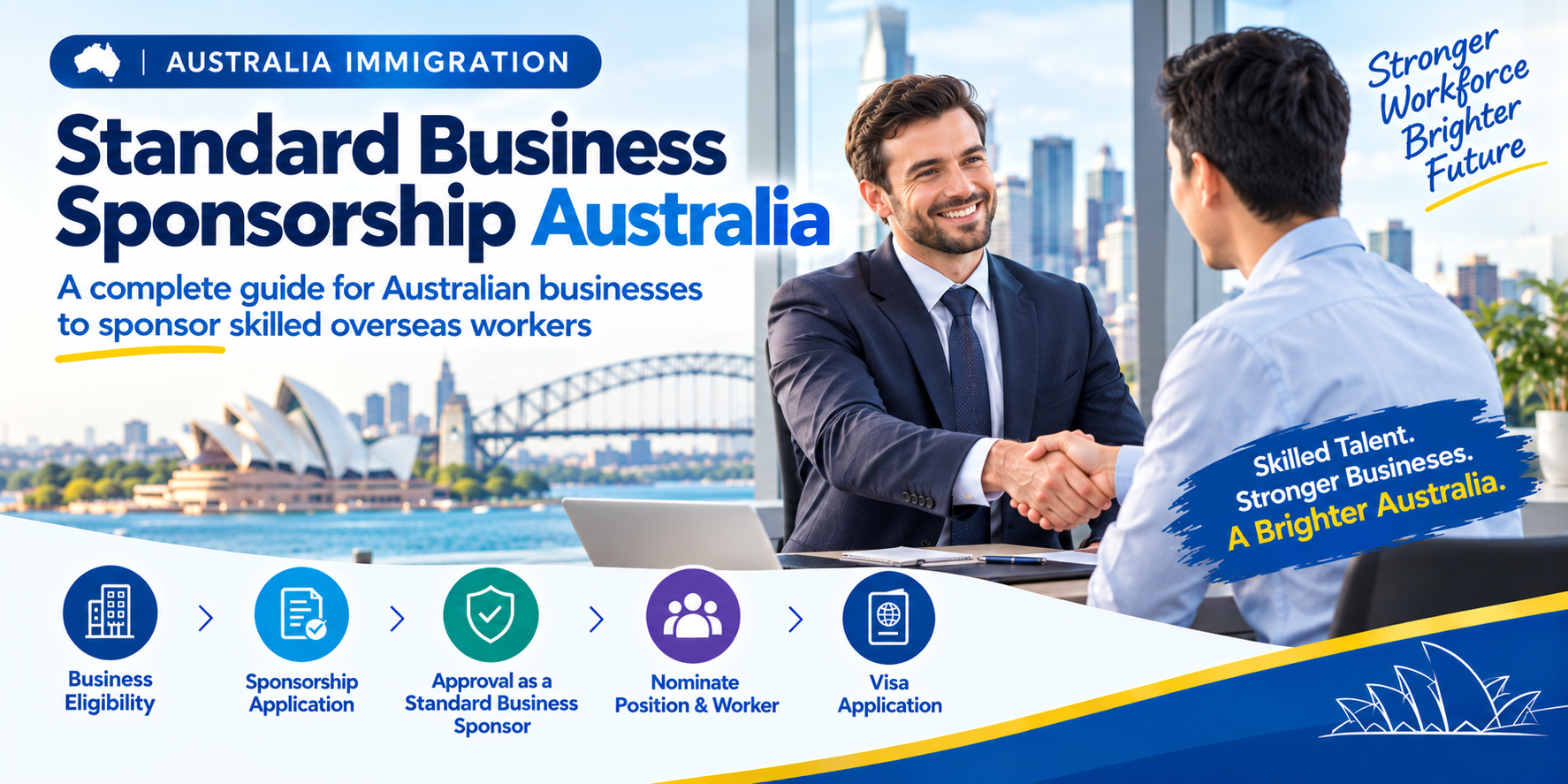
Step 1: Assess the business
The employer reviews whether the business and its circumstances meet the sponsorship requirements.
Step 2: Apply for sponsorship
The business submits the relevant sponsorship application and supporting information to the Department of Home Affairs.
Step 3: Obtain sponsorship approval
If approved, the business becomes a Standard Business Sponsor and can use the sponsorship arrangement for eligible employer-sponsored pathways.
Step 4: Nominate the position and worker
The employer then proceeds with the relevant nomination process. The position and proposed worker must meet the requirements of the selected visa program.
Step 5: Visa application
The nominated worker submits the relevant visa application and must satisfy the applicable visa criteria.
Importantly, sponsorship, nomination and visa applications are separate stages. Approval at one stage does not automatically guarantee approval at another.
What Are the Obligations of a Standard Business Sponsor?
Becoming a sponsor involves ongoing responsibilities. Employers must understand these obligations before sponsoring an overseas worker.
For example, sponsors must notify the Department about certain changes involving the business or sponsored employee. This can include changes to business details, changes in the employee’s duties, or the end of the employee’s employment. Some notifications must be made within 28 calendar days.
Sponsors must also ensure that sponsored employees work in the nominated occupation and receive employment conditions that comply with the relevant requirements. Where applicable, employment conditions cannot be less favourable than those provided to an equivalent Australian worker.
Record-Keeping and Compliance
Record keeping is an important part of Standard Business Sponsorship Australia.
Sponsors may need to maintain records relating to employment contracts, duties performed, remuneration, notifications, sponsored workers and other matters demonstrating compliance with sponsorship obligations.
The Department may request relevant records or information to assess whether sponsorship obligations are being met.
Employers should therefore establish appropriate internal processes for maintaining sponsorship and employment records.
What Happens If a Sponsor Does Not Meet Its Obligations?
Sponsorship obligations are legally significant. Failure to comply can result in various actions, depending on the circumstances.
The Department states that possible consequences can include compliance notices, cancellation of sponsorship approval, restrictions on future sponsorship applications and financial penalties.
This is why businesses should treat sponsorship compliance as an ongoing responsibility rather than a one-time application.
Standard Business Sponsorship and the Subclass 482 Visa
The Skills in Demand visa (subclass 482) is one of the key visa pathways associated with employer sponsorship. A suitable employer may sponsor an overseas skilled worker where the relevant requirements are satisfied.
However, the employer must meet the sponsorship and nomination requirements, while the applicant must separately satisfy the applicable visa criteria.
Businesses should assess the occupation, position, salary, employment arrangements and applicant circumstances before proceeding.
Can Standard Business Sponsorship Lead to Permanent Residence?
A Standard Business Sponsorship (SBS) does not provide permanent residency by itself.
However, an employer-sponsored worker may, depending on their individual circumstances, eligibility, and the visa options available at the time, be able to transition to a permanent residence pathway through an appropriate employer-sponsored visa.
The eligibility requirements for permanent residence are separate and should be assessed independently rather than assumed from sponsorship approval.
Frequently Asked Questions
What is Standard Business Sponsorship in Australia?
Standard Business Sponsorship is an approval granted to eligible Australian businesses, enabling them to sponsor qualified overseas workers under relevant employer-sponsored visa programs, subject to the applicable requirements.
How long does Standard Business Sponsorship last?
The duration of a business sponsorship approval is determined by the relevant sponsorship rules and the terms of the approval granted to the business. Employers should check the current Department of Home Affairs requirements when applying or renewing sponsorship.
Can a small business become a Standard Business Sponsor?
A small business may be able to apply if it meets the relevant legal and sponsorship requirements. Business size alone does not determine eligibility.
Does sponsorship guarantee a visa?
No. Having an approved sponsorship does not automatically result in a successful nomination or the grant of a visa. Each nomination and visa application must separately satisfy the applicable eligibility and assessment requirements.
Does an employer have ongoing responsibilities after sponsorship approval?
Yes. Sponsors must continue meeting their sponsorship obligations, including notification, employment, record-keeping and other compliance requirements.
Final Thoughts
Standard Business Sponsorship in Australia can give eligible businesses a structured pathway for engaging skilled workers from overseas, subject to the relevant sponsorship and visa requirements.. However, the process involves more than simply obtaining sponsorship approval. Employers need to consider business eligibility, occupation requirements, nomination criteria, visa requirements and ongoing sponsorship obligations.
Because Australian migration requirements can change, businesses should review the current rules before starting the sponsorship process and obtain professional advice where appropriate.
Employers planning to recruit skilled workers from overseas can benefit from reviewing their business requirements, the nominated role, and the prospective employee’s circumstances to determine a suitable sponsorship and visa option.
Keywords covered naturally: Standard Business Sponsorship Australia, standard business sponsorship, SBS Australia, Australian employer sponsorship, employer sponsored visa Australia, skilled worker sponsorship Australia, subclass 482, employer sponsorship Australia.