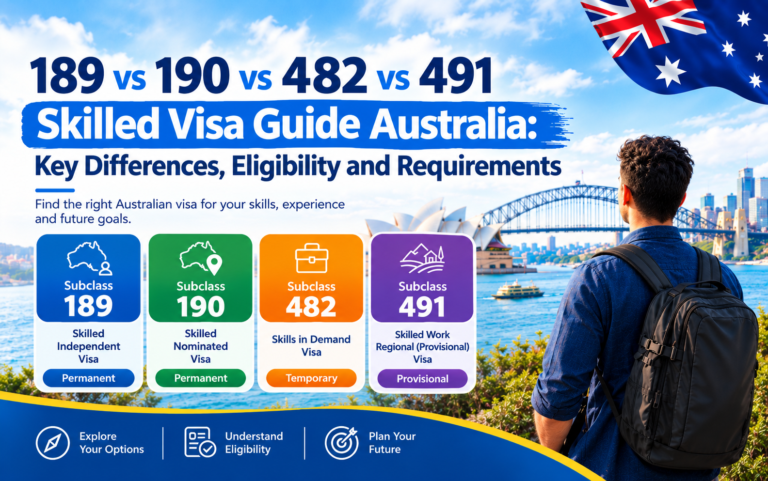

189 vs 190 vs 482 vs 491 Skilled Visa Guide Australia: Key Differences, Eligibility and Requirements
- Author Name : Shreya Yadav
- Published on October 22, 2026
- Category : Australia Migration
Selecting a suitable Australian visa is a key decision for skilled workers seeking employment opportunities, long-term residency, or a brighter future in Australia. The 189, 190, 482 and 491 visas offer different opportunities depending on your qualifications, work experience, occupation, sponsorship options and long-term goals.
Understanding the differences between these Australian skilled migration pathways can help you identify which option may suit your circumstances. This guide explains the main features, eligibility requirements and potential benefits of each visa.
1. Subclass 189 Visa: Skilled Independent Visa
The Subclass 189 Skilled Independent Visa provides eligible skilled professionals with an opportunity to obtain Australian permanent residency without requiring sponsorship from an employer or nomination by a state or territory. Successful applicants can live and work across Australia, subject to the visa’s conditions.
As a points-tested visa, the Subclass 189 pathway assesses applicants on factors such as their occupation, skills assessment, English language proficiency and other eligibility criteria. Applicants must submit an Expression of Interest (EOI) and receive an invitation to apply, while meeting the applicable requirements for their circumstances.
Key eligibility requirements
Applicants generally need to:
- Be under 45 when invited to apply.
- Nominate an occupation eligible for the visa stream.
- Obtain a suitable skills assessment.
- Meet the applicable English-language requirements.
- Submit an Expression of Interest (EOI) through SkillSelect.
- Achieve the required points score and obtain an invitation to apply.
- Satisfy health and character requirements.
Although 65 points is generally the minimum threshold for points-tested skilled visas, reaching this score does not guarantee an invitation.
Who should consider the 189 visa?
This pathway may suit skilled professionals with competitive points scores who want permanent residency without depending on an employer or state nomination.
2 . Subclass 190 Visa: Skilled Nominated Visa
The Subclass 190 Skilled Nominated Visa offers eligible skilled professionals a pathway to Australian permanent residency through nomination by a state or territory government.
This points-tested visa requires applicants to secure the relevant nomination and satisfy the eligibility criteria set by the nominating state or territory, along with the applicable visa requirements.
Key eligibility requirements
Applicants generally need to:
- Have an eligible occupation.
- Obtain a suitable skills assessment.
- Meet the applicable English-language requirements.
- Submit an EOI through SkillSelect.
- Meet the points criteria and secure an invitation to apply.
- Secure state or territory nomination.
- Satisfy health and character requirements.
State and territory governments may apply additional requirements relating to occupation demand, employment history, qualifications, residence or work experience. These requirements can change, so applicants should check the relevant government’s current nomination guidelines.
Who should consider the 190 visa?
The 190 visa may suit skilled workers seeking permanent residency who meet a state’s or territory’s nomination requirements. Applicants should be aware of the settlement commitments in the state or territory that nominates them.
3 . Subclass 482 Visa: Skills in Demand Visa
The Subclass 482 Skills in Demand visa allows eligible skilled professionals to work temporarily in Australia with sponsorship from an approved employer. It allows businesses to address workforce needs when they cannot fill certain positions through the available local workforce.
Unlike the 189 and 190 visas, the 482 visa is primarily employer-sponsored rather than points-tested.
Key eligibility requirements
Applicants generally need to:
- Have an eligible job offer from an approved sponsoring employer.
- Meet the applicable occupation and stream requirements.
- Possess the skills, qualifications and experience required for the nominated role.
- Meet relevant English-language requirements, unless an exemption applies.
- Satisfy health, character and other visa conditions.
Required work experience varies according to the visa stream and applicable criteria, so applicants should check the latest conditions before applying.
Depending on the stream and individual circumstances, the visa may permit a stay of up to four years. Eligible visa holders may also have the option to pursue employer-sponsored permanent residency through pathways such as the Subclass 186 visa, subject to meeting the relevant requirements.
Who should consider the 482 visa?
This pathway may be appropriate for skilled workers with an Australian employer prepared and qualified to provide sponsorship. It can be useful for people whose immediate priority is obtaining sponsored employment rather than pursuing a points-tested visa.
4 . Subclass 491 Visa: Skilled Work Regional (Provisional) Visa
The Subclass 491 Skilled Work Regional (Provisional) Visa is designed for eligible skilled workers who intend to live and work in designated regional areas of Australia.
This five-year provisional visa requires an eligible nomination by a state or territory government or sponsorship by an eligible relative, depending on the applicable pathway. Applicants need to satisfy the applicable occupation criteria, points threshold and invitation requirements.
Key eligibility requirements
Applicants generally need to:
- Have an eligible occupation.
- Obtain a suitable skills assessment.
- Meet the applicable English-language requirements.
- Submit an EOI through SkillSelect.
- Receive an invitation and meet the points test.
- Obtain eligible state or territory nomination or qualifying family sponsorship.
- Meet health and character requirements.
Visa holders must comply with applicable regional residence, work and study conditions.
Eligible 491 visa holders may later apply for permanent residency through the Subclass 191 visa if they satisfy the relevant requirements. A Subclass 491 visa does not automatically lead to permanent residency; applicants must meet the relevant eligibility conditions.
Who should consider the 491 visa?
This visa may be suitable for skilled professionals willing to live and work in regional Australia who satisfy the applicable state nomination or eligible family sponsorship criteria. For those who meet the required conditions, it may also offer a pathway to permanent residency.
5 . Key Differences Between the 189, 190, 482 and 491 Visas
Feature | Subclass 189 | Subclass 190 | Subclass 482 | Subclass 491 |
Visa type | Permanent | Permanent | Temporary | Provisional |
Sponsorship | Not required | State or territory nomination | Employer sponsorship | State nomination or eligible relative sponsorship |
Points-tested | Yes | Yes | Generally no | Yes |
Job offer | Generally not required | Generally not required | Required | Generally not required |
Regional conditions | No specific regional restriction | Nomination-related expectations may apply | Depends on visa conditions | Regional conditions apply |
Potential PR outcome | Permanent residency | Permanent residency | Possible separate pathway | Possible Subclass 191 pathway |
The most suitable visa depends on your individual profile, occupation, experience, English proficiency, points score and sponsorship opportunities.
6 . How to Choose the Right Australian Visa
Before selecting a skilled migration pathway to Australia, review your qualifications, professional background, eligible occupation and future settlement goals.
If you have a strong points score and prefer flexibility in where you live, the 189 visa may be worth exploring. If you meet a state’s nomination criteria, the 190 visa could be another permanent residency option.
If an Australian employer is ready to sponsor you, the 482 visa may be relevant. If you are willing to live and work in regional Australia, the 491 visa may provide an alternative pathway.
Review the current Department of Home Affairs requirements before making a decision. Occupation lists, nomination rules, visa fees and eligibility criteria can change.
Frequently Asked Questions
1 . Which Australian visa is best for permanent residency?
The 189 and 190 visas grant permanent residency to successful applicants. Eligible 491 and 482 visa holders may have separate pathways to permanent residency if they meet the applicable requirements.
2 . Is 65 points enough for a 189 or 190 visa?
Sixty-five points is generally the minimum threshold for these points-tested visas. However, meeting the minimum does not guarantee an invitation or nomination.
3. Can I apply for the 190 visa without state nomination?
No. State or territory nomination is a core requirement of the Subclass 190 visa.
4 . Does the 482 visa lead to permanent residency?
Some 482 visa holders may qualify for an employer-sponsored permanent residency pathway. Eligibility depends on the relevant visa rules and individual circumstances.
5 . Can the 491 visa lead to permanent residency?
Eligible 491 visa holders may apply for the Subclass 191 visa after meeting the applicable requirements, including relevant visa-holding and compliance conditions.
Conclusion
Understanding the differences between the 189 vs 190 vs 482 vs 491 visa options can help you plan your Australian migration journey. Each pathway has distinct requirements, benefits and limitations, so choosing the right option requires careful assessment.
Orbit Migration Advisory can help you understand the relevant eligibility criteria, documentation requirements and application process for your circumstances.
Planning your Australian migration journey?
Contact Orbit Migration Advisory to discuss your options.
Website: orbitmigrationadvisory.com
Disclaimer: This article provides general information only and is not immigration or legal advice. Visa requirements and policies may change. Review the latest visa guidelines published by Australia’s Department of Home Affairs before submitting your application.