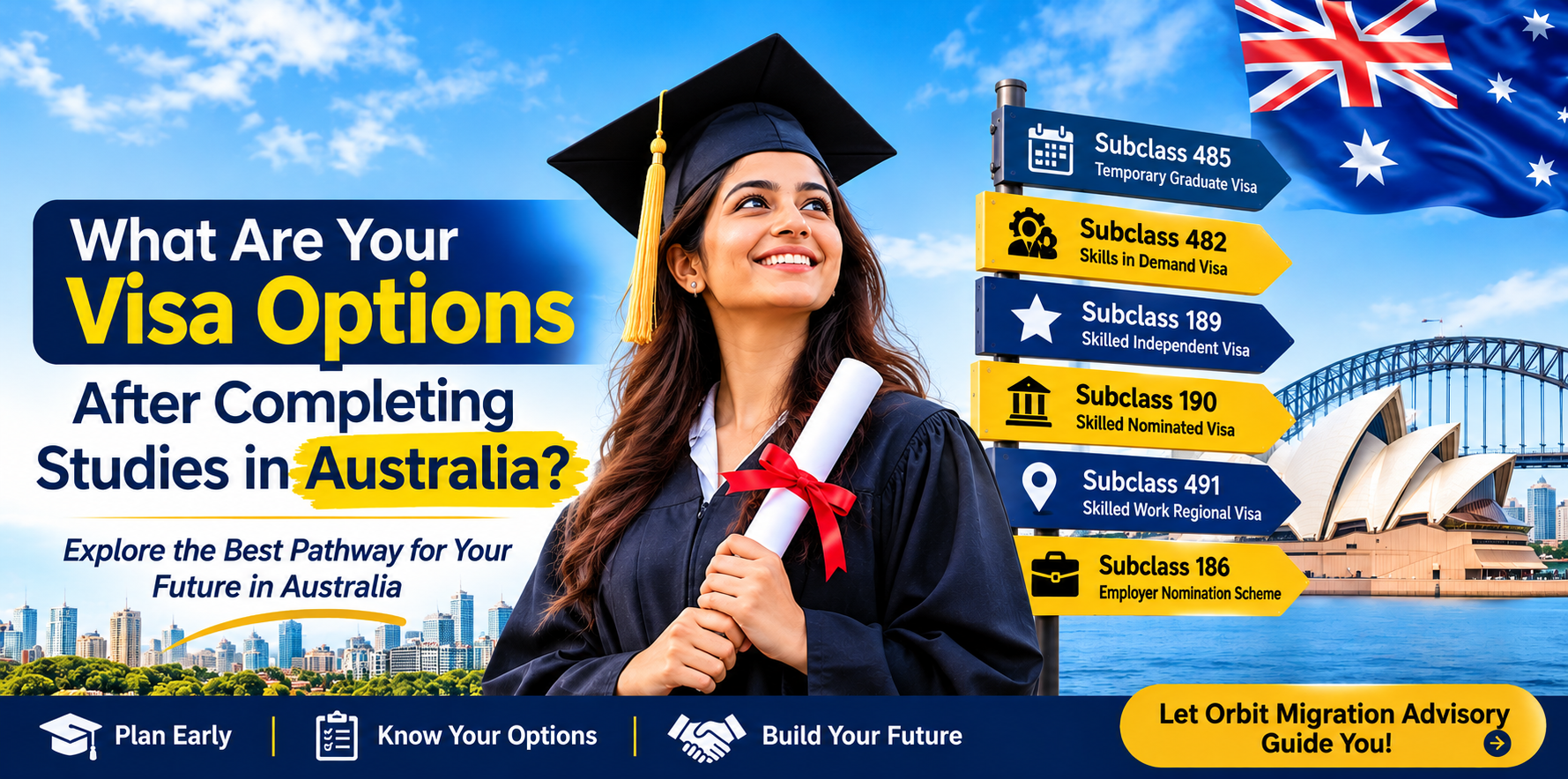
What Are Your Visa Options After Completing Studies in Australia?
- Author Name : Shreya Yadav
- Published on November 04, 2026
- Category : Australia Migration
Finishing one’s academic pursuits in Australia represents a significant milestone, yet for numerous international students, graduation merely initiates a new chapter rather than concluding their Australian odyssey. This transition offers a pivotal opportunity to investigate professional career trajectories, acquire substantive work experience, and potentially forge a pathway toward permanent residency.
Gaining a comprehensive understanding of the visa pathways available upon the completion of your studies in Australia is paramount prior to the expiration of your current Student Visa (Subclass 500). Eligibility for these distinct Australian visa categories is contingent upon a multifaceted assessment of your qualifications, age, professional occupation, accrued work experience, and specific personal circumstances.
Transitioning from a Temporary Graduate Visa (Subclass 485) to pathways for skilled migration or employer-sponsored visas presents a multitude of strategic options that merit careful consideration. This guide delineates the primary visa categories available post-graduation and outlines a structured approach to planning your subsequent professional trajectory.
1. Temporary Graduate Visa (Subclass 485)
Among the most sought-after pathways for eligible international students who have recently concluded their academic pursuits in Australia is the Temporary Graduate Visa (Subclass 485). This visa category grants graduates the capacity to reside, engage in employment, and undertake further studies within Australia following the successful completion of a qualifying course.
The visa system is segmented into distinct streams, each tailored to align with specific educational qualifications.
The Post-Higher Education Work Stream is accessible to qualifying graduates holding a bachelor’s, master’s, or doctoral degree. The authorized duration of residence typically spans two to three years, contingent upon the specific level of academic qualification attained.
The Post-Vocational Education Work Stream is specifically tailored for qualified graduates holding an associate degree, diploma, or trade qualification that aligns closely with a profession listed on the relevant skilled occupation roster, granting a general period of stay of up to eighteen months.
The Second Post-tertiary Education Work Stream, qualified graduates who completed their studies at an Australian institution located in a designated regional area become eligible for an extension of their stay lasting one to two years, contingent upon satisfying regional residency stipulations and adhering to additional mandatory criteria.
Who can apply for a 485 Graduate Visa?
Applicants generally need to:
- Possession of a valid student visa issued within the preceding six months is a requisite condition.
- Possess a visa that meets eligibility criteria.
- Possession of a valid student visa issued within the preceding six months is a requisite condition.
- To fulfill the Australian study requirements.
- Have completed an eligible CRICOS-registered qualification.
- Satisfy the stipulated criteria pertaining to English proficiency, health standards, and character.
- Please submit the requisite documentation.
While the Subclass 485 visa offers a significant opportunity to accrue professional experience within Australia and investigate potential future migration routes, satisfying the requisite eligibility criteria does not inherently ensure visa approval.
2. Skills in Demand Visa (Subclass 482)
The Skills in Demand Visa (Subclass 482) presents a viable pathway for graduates who have cultivated pertinent professional competencies and obtained employment with a qualifying Australian entity.
In contrast to the Temporary Graduate Visa, this migration pathway necessitates employer sponsorship and the nomination of a qualifying position.
The main requirements generally include:
- A qualified Australian employer prepared to provide sponsorship.
- Possess the appropriate skills, qualifications and professional background required for the nominated position.
- A minimum of twelve months of pertinent professional experience is required.
- Applicable English language requirements.
- Satisfying the requisite standards for both compensation and professional standing.
The visa program comprises multiple pathways, specifically encompassing both the Core Skills and the Specialist Skills streams.
Graduates who acquire pertinent professional experience following their academic qualifications should consider employer-sponsored visas as a viable option for either temporary or extended migration opportunities.
3. Skilled Independent Visa (Subclass 189)
The Skilled Independent Visa (Subclass 189) constitutes a points-assessed route to permanent residency designed for qualified skilled professionals, operating without the necessity of employer sponsorship or state nomination.
Eligible international graduates, whose professional experience, academic credentials, and transferable competencies satisfy the prescribed criteria for skilled migration, may pursue this pathway.
Key considerations include:
- Being under 45 years old at the time of invitation, subject to applicable exemptions.
- Possession of a designated occupation that qualifies for eligibility..
- Securing an appropriate skills assessment.
- Achieving the requisite threshold of points.
- Demonstrating the required English language proficiency.
- Lodging an Expression of Interest (EOI) via the SkillSelect system.
- Having been granted the opportunity to submit an application.
While your Australian qualification can serve as a significant component in calculating your points score, the mere completion of an Australian degree does not, in itself, grant eligibility for permanent residency.
4.Skilled Nominated Visa (Subclass 190)
The Skilled Nominated Visa (Subclass 190) represents a pathway to permanent residency for qualified skilled professionals who have been nominated by a state or territory government in Australia.
Prospective graduates should evaluate this pathway only when their professional profile and personal circumstances satisfy the specific nomination criteria established by the relevant state.
Typically, candidates must secure a competent skills assessment, satisfy the criteria for an eligible occupation, attain the requisite points threshold, and receive an invitation to proceed with their application.
Given that every state and territory establishes distinct occupational priorities, nomination prerequisites, and supplementary eligibility stipulations, it is imperative to scrutinize the pertinent nomination criteria prior to lodging an Expression of Interest.
5. Skilled Work Regional Visa (Subclass 491)
The Skilled Work Regional Visa (Subclass 491) functions as a provisional skilled migration instrument, designed for qualified candidates seeking to establish residence and pursue employment within Australia’s designated regional zones.
Typically, candidates must secure either a nomination from a qualifying state or territory government or obtain sponsorship from an eligible family member residing within a designated regional zone.
This pathway may be suitable for graduates interested in regional employment and migration opportunities.
Eligible visa holders may later explore permanent residency through the Subclass 191 visa if they satisfy the applicable requirements.
6.Employer Nomination Scheme Visa (Subclass 186)
The Employer Nomination Scheme Visa (Subclass 186) is another permanent residency option for eligible skilled workers who have an Australian employer willing to nominate them.
Depending on the circumstances, applicants may explore the Temporary Residence Transition or Direct Entry streams.
Relevant factors include employment history, occupation, skills, qualifications, age and English language ability. Different streams have different requirements.
Graduates who build relevant professional experience and establish an eligible employment relationship may consider this pathway for their longer-term Australian migration plans.
7.Other Visa Options After Graduation
Not every graduate follows a skilled migration or employer-sponsored pathway. Other suitable visa pathways may also be available based on your personal situation, eligibility and future plans:
Partner Visa (Subclass 820/801 or 309/100): Available to eligible applicants in genuine relationships with Australian citizens, permanent residents or eligible New Zealand citizens.
Student Visa (Subclass 500): May be suitable if you genuinely intend to undertake further eligible studies and satisfy the Student Visa requirements.
Visitor Visa (Subclass 600): May be considered for eligible temporary visits, tourism or visiting family. This visa does not provide general work rights.
Choosing the right visa depends on your circumstances, eligibility and future plans.
Important Things to Consider Before Your Student Visa Expires
Before deciding on your next Australian visa, consider these important steps:
- Check your current visa conditions: Review your visa expiry date and conditions through VEVO.
- Understand your eligibility: Compare your qualifications, age, occupation and experience against the relevant visa criteria.
- Prepare your documents: Organise academic transcripts, completion letters, English test results and other supporting evidence.
- Understand application deadlines: Some visa pathways have strict time limits after course completion or invitation.
- Plan your next step early: Avoid waiting until your current visa is close to expiring before exploring suitable options.
Completing your course does not grant an automatic extension of your Australian stay; you must hold a valid visa to remain in the country lawfully.You must maintain lawful immigration status and comply with your visa conditions.
Conclusion
Completing your education in Australia can open the door to several professional and migration opportunities. Whether you want to gain work experience through a Temporary Graduate Visa (Subclass 485), explore employer sponsorship through a Subclass 482 visa or investigate permanent residency through skilled migration, understanding your options is the first step.
The best visa option after completing studies in Australia depends on your individual eligibility, qualifications, career goals and immigration circumstances. Planning early can help you make informed decisions and avoid unnecessary complications.
Orbit Migration Advisory is here to guide you through suitable Australian visa pathways, evaluate your eligibility and help you navigate the next stage of your migration journey.
Your graduation is just the beginning of new opportunities in Australia.
Let us help you plan what comes next!
Visit: https://orbitmigrationadvisory.com/
Frequently Asked Questions (FAQs)
- What are the visa options after completing studies in Australia?
Eligible graduates may explore the Temporary Graduate Visa (Subclass 485), Skills in Demand Visa (Subclass 482), skilled migration visas (Subclass 189, 190 and 491), Employer Nomination Scheme (Subclass 186) and other suitable visa pathways.
- Can I stay in Australia after my student visa expires?
You must hold a valid visa or another lawful basis to remain in Australia. You should explore an appropriate visa pathway before your current visa expires.
- Can I apply for permanent residency after studying in Australia?
Yes. Eligible graduates may explore skilled migration, employer-sponsored or partner visa pathways. However, completing an Australian qualification does not automatically guarantee permanent residency.
- Do all international students need to apply for a 485 visa after graduation?
No. Applying for a Subclass 485 visa is not mandatory after completing your studies. Graduates can consider alternative Australian visa pathways based on their qualifications, eligibility and future migration goals.
- Can I apply for a 482 visa after completing my studies?
Potentially, yes. You must meet the Skills in Demand visa requirements, including relevant work experience, and have an eligible sponsoring employer.
- Can I extend my 485 Graduate Visa?
A standard Subclass 485 visa cannot simply be extended. However, eligible graduates may qualify for the Second Post-Higher Education Work stream or explore other visa pathways.
- Can I work in Australia after completing my course?
Your work rights depend on your current visa conditions. A granted Subclass 485 visa generally provides work rights during its validity.
- Can I apply for a skilled visa without employer sponsorship?
Yes. The Skilled Independent Visa (Subclass 189) and Skilled Nominated Visa (Subclass 190) do not require employer sponsorship, although they have separate nomination, points and invitation requirements.